Once a cataract has been diagnosed, you'll need to determine your ideal treatment approach. In this section, you will learn about the various surgical and non-surgical technologies that are used in cataract care.
It is a fact that cataracts are irreversible. Just as one cannot unboil an egg, one cannot reverse a cataract once it has formed. Most patients diagnosed with a cataract are faced with a choice of either coping with the symptoms, while trying to address them with glasses or contacts, or undergoing the definitive treatment of cataract extraction.
Surgical options for cataracts
The definitive treatment for cataracts is cataract extraction. There are several widely accepted indications for requiring cataract surgery:
- Vision has become so inadequate that it interferes with everyday tasks, such as driving, watching TV, reading, hobbies, etc.
- The cataract is causing glaucoma and inflammation
- The cataract is threatening irreversible loss of vision.
- The cataract precludes the view of the back of the eye and is interfering with the treatment of a retinal problem such as diabetic retinopathy or macular degeneration.
Modern cataract extraction includes several options, depending on the general status of your eye and your surgeon's skillset. Your candidacy for the various procedures is best discussed at length during your visit to the Benjamin Eye Institute in Los Angeles. With that said, some of the options for your procedure include:
Phacoemulsification
Before the advent of phacoemulsification by the late Dr. Charles Kellman in the 1970's, cataract surgery was a big deal. It involved making a large (12mm) incision with the subsequent removal of the whole cataract. The removal of a cataract was termed extracapsular cataract extraction, and was akin to removing a pit from a cherry. This surgery was associated with a lengthy post-operative recovery period, as the large incisions required many stitches. The stitches caused a high degree of post-operative astigmatism, necessitating strong glasses prescriptions.
The unrelenting progress of science and technology has led to the development of phacoemulsification and clear corneal micro-incisions (less than 2mm) that are self-sealing and require no stitches. The lens technology has advanced to the point where a foldable lens is inserted through the microscopic opening. This means that in capable hands, cataract extraction takes 5 to 7 minutes, with the patient enjoying greatly improved vision almost instantaneously in the recovery room.
Refractive cataract extraction
Extraction of a visually significant cataract is widely considered a medically necessary procedure, covered by health insurance. The goal of standard cataract surgery is the best corrected visual acuity (best possible vision with glasses). This is achieved through extraction of the cloudy lens and its replacement with an artificial monofocal lens implant, without correcting coexisting astigmatism.
This form of standard cataract surgery is safe, quick and painless. However, while this procedure improves vision, it leaves most patients with a need for both distance and reading glasses. This means that while the surgeon makes the best possible effort to eliminate the need for glasses, given the limitations of the technology utilized, glasses will most likely be necessary.
Premium or refractive cataract extraction has a much heftier goal. This kind of surgery aims to completely eliminate the need for glasses or contacts. Through the use of specialized multifocal or toric lens implants and additional surgical manipulations to reduce astigmatism, the result is improved vision without the need for glasses or contacts.
Laser-assisted cataract care
The Benjamin Eye Institute offers laser cataract surgery at our state-of-the-art Los Angeles surgical facility for patients who wish to attain restored, clear vision. As a premier laser cataract surgery provider, Dr. Benjamin has extensive experience with this convenient, effective and comfortable solution for the removal and replacement of cataracts.
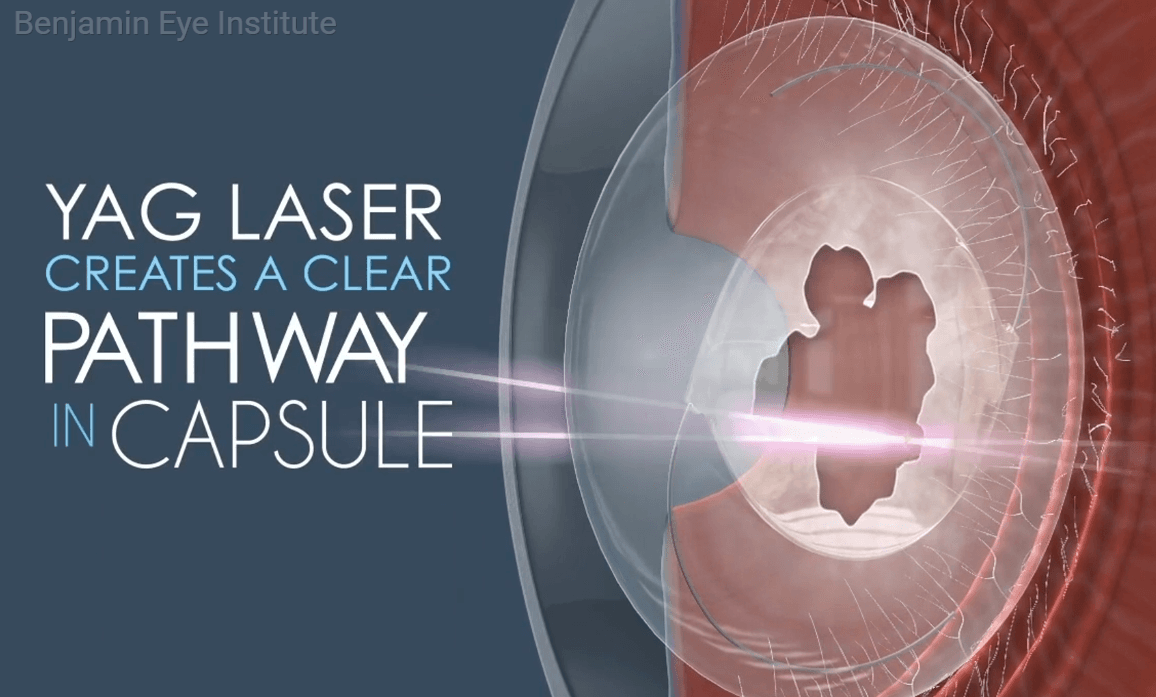
The same technology that has for years been utilized for LASIK is now FDA-approved for cataract surgery. It has long been a dream of vision scientists and eye surgeons to harness the power of the laser and bring its computer controlled precision to the treatment of cataracts. Finally, this has become a reality with the FDA approval of the Alcon LensX System. Its ultra-short pulses create precise cuts in tissue with minimal collateral damage. The steps of cataract surgery that were previously performed with blades and ultrasonic probes, can now be performed with the laser.
Non-surgical cataract treatment options
The non-surgical alternative to cataract extraction is to continue wearing spectacles or contact lenses. Although there are essentially no risks to wearing glasses, the quality of vision will not be optimal because the cataract will continue to cause degradation.
In addition, if the prescription is very high, it will result in a greatly enlarged or reduced image and a decrease in peripheral vision caused by the thickness of the lens. Although contact lenses may provide higher quality and more normal vision, they carry a slight risk of complications, especially if they are worn overnight. The risks of contact lenses include: infection, which if involving the central cornea can rarely cause loss of vision, allergies, which can make wearing the lenses difficult, mild irritation; and discomfort.
Treating both cataracts and astigmatism
Sometimes, the surface of the cornea is curved more like a football, with both flatter and steeper curves, than like a spherical basketball. When the surface of the cornea has an uneven curvature, the resulting vision is distorted. This common irregularity, called 'corneal astigmatism,' causes blurred vision because light rays are not focused at one spot to provide clear eyesight.
A person who has both a cataract and a corneal astigmatism will not regain high-quality distance vision after cataract surgery unless the astigmatism is also corrected. Conventional cataract surgery is able to eliminate nearsightedness or farsightedness, but it cannot correct other refractive errors such as astigmatism.
There are a few astigmatism correcting options available to be used in conjunction with cataract surgery. They include:
- LRI
- LASIK
- TORIC IOL
- Glasses & Contact Lenses
If you're diagnosed with astigmatism, Dr. Benjamin and his team will often recommend Limbal Relaxing Incisions, or LRIs. LRIs are grooved incisions placed on the far peripheral aspect of the cornea (the limbus) resulting in a cornea that is more perfectly shaped. The astigmatism is thus reduced and vision improved. The reduction or elimination of the astigmatism results in better quality vision without glasses. After an LRI procedure, you will not need glasses for better vision at a distance. However, reading glasses will still be required.
Meet our founder and chief surgeon, Dr. Arthur Benjamin
Dr. Benjamin is recognized as a leading authority on cataract treatment in Los Angeles. Patients come to our facility in order to achieve remarkable vision correction results with among the best cataract surgeon available. His procedures are safe, precise and highly effective, and tend to offer extremely reliable ways for patients to manage their cataracts and achieve clearer, sharper vision.