310.275.5533
call or text
310.275.5533
call or text
Home » Ophthalmology Blog » Glaucoma, Eye floaters and Symfony (2)

Glaucoma, Eye floaters and Symfony (2)

Published: November 20, 2022

Part 2. IStent is an FDA-approved implantable device that reduces the intraocular pressure, slowing down the loss of vision from glaucoma. IStent can be performed in conjunction with the cataract surgery and it is very safe and effective.

Glaucoma, Eye floaters and Symfony (2)

GLAUCOMA, EYE FLOATERS AND SYMFONY (2)

Are there many people that need this shunt?

At Benjamin Eye Institute, practically every other patient has glaucoma, and the patient’s intraocular pressure will be normal for about 7 years.

Many people ask: “Why is it called Benjamin Eye Institute when there’s only oneDoctor Benjamin?”

He is not alone! We have many specialists.  Ophthalmology has seven disciplines with corresponding specialists for the cornea, glaucoma, plastic surgery, neuro-ophthalmology, and so on.  I do refractive surgery and general ophthalmology, and there are clearly things that aren’t my area of expertise.  I can look at the retina and determine if someone has macular degeneration (or a number of other things), but its treatment should be left to dedicated specialists.  One of the most in-demand is the retina specialist.  Previously, we had to refer patients to other offices, which is problematic.  We don’t know what kind of insurance others take, and it isn’t always clear who will take the patient, so we hired a retina specialist of our own, Pamela Golchet.  She has been with us for about a year-and-a-half.

Some people are afraid of the word “retina”, and think someone will go in there and make things worse. 

You should be scared of random doctors, but not proven specialists.  Pamela Golchet can give an objective opinion on whether the patient needs an operation.  For example, are there holes in the retina, or just floaters and flashes?

I’m familiar with floaters.  I see them all day.  I have this idea that all these spots and  blurs are the consequence of old cataract surgery, and not because I didn’t receive the operation from you (I didn’t know about Benjamin Eye at the time), but because of the procedure itself.  Is that possible?

That’s a great question.  4/5 of the eye’s volume is filled with a gelatinous substance called the vitreous body.  It fills a shell that holds the shape of the eye and is rigid, or minimally elastic.  The other 1/5 is various muscles on the outside, with the lens, iris, retina inside.  That vitreous body allows light through to the retina and is composed of 20% hyaluronic acid which keeps a water between its long chemical chains.  With age, these chains decompose, so the gelatinous center thins, shrinks, and peels off the back wall of the eye.  This is what causes persistent floaters.

Is there a method for getting rid of them?

There’s vitrectomy, which can remove all kinds of floaters and spots.  But this operation is complicated, expensive, and also risky.  Methods for splitting large floaters into hundreds of smaller ones are available, but the YAG laser used in these procedures causes trauma that can translate into retinal detachment or glaucoma.  Among serious ophthalmologists, doctors who use these procedures do not have the best reputation.

What specifically causes their development?

It is often spontaneous.  You’re not doing anything special, maybe reading a book or watching tv, and it happens suddenly.  Also after head injuries from a fall or sports like boxing.  The eyes have the fastest muscles in the body.  After the peeling has occurred, fragments of the vitreous body move about and can’t keep up with the movement of the eye, while progressively more peels off and conglomerates…  These cast shadows and are seen as floaters.

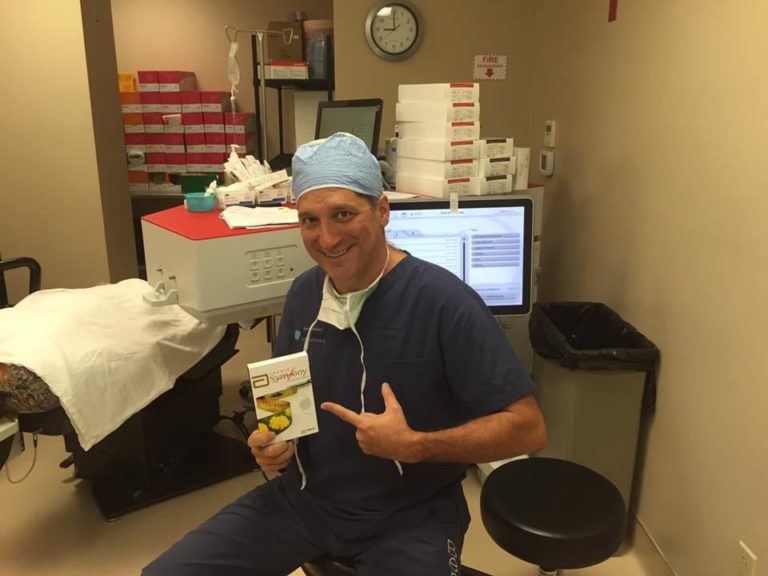
As far as I can tell, the new generation of Symfony lenses has caused quite a stir.  You were the first surgeon in Los Angeles to use Restore, which at that time were cutting-edge, and now you’ve done it again!  Remind me what makes Symfony so revolutionary. 

Regular multifocal lenses allow you to see things in the distance and up close, but aren’t as good in mid-distances – interpersonal communication, the computer, shopping, speedometer, GPS…  In addition, there are problems with halos, reflections, rays, loss of contrast perception and partial loss of light.  Conventional lenses lose about 20% of light, and in the case of astigmatism, the result heavily depends on corneal procedures.  People often complain that they can see everything, but there isn’t enough light.  Now, finally, there’s a lens that solves all these problems.

Yes, it is a powerful step forward.  A new quality of life. 

This is a phenomenal invention – a complex diffractive lens with an excellent resolution!  Manufacturing such a lens is extremely difficult.  If you’re creating it for a huge telescope, it costs hundreds of thousands of dollars, but so does this tiny lens on an industrial scale.

I hope we can continue to talk about them next time.  In the meantime, I have questions from our readers:

Are Symfony lenses perfect, or where can they improve?

  1. Are other lenses doomed?
  2. Can a method for cataract treatment be invented that doesn’t involve a replacement lens?
  3. If these lenses do not suit the patient, what can be done?
  4. Is there a waiting list?  If so, how long is the wait?
  5. Have they been tested on others?
  6. Is there a way to prevent cataracts?

Thank you.

Back

SEE WHAT OURPATIENTS HAVE TO SAY

Posted on Google Google
Jim B profile picture
Jim B
Google star 1Google star 2Google star 3Google star 4Google star 5Trustindex verifies that the original source of the review is Google.
Everyone is always pleasant and kind and attentive. Focused and on schedule.

Owner's reply
Thank you for your wonderful feedback, Jim! We're thrilled to hear you had a great experience from start to finish. Your recommendation means a lot to us! We look forward to serving you again in the future.
Posted on Google Google
Nick Ben-Meir profile picture
Nick Ben-Meir
Google star 1Google star 2Google star 3Google star 4Google star 5Trustindex verifies that the original source of the review is Google.
Efficient service, and Dr Benjamin ahead of the curve, as always

Owner's reply
Thank you for your 5-star review, Nick!
Posted on Google Google
sharon piehl profile picture
sharon piehl
Google star 1Google star 2Google star 3Google star 4Google star 5Trustindex verifies that the original source of the review is Google.
Everyone was very kind and I felt comfortable being there for the first time.

Owner's reply
Dear Sharon, Thank you so much for your kind review. We’re so glad to hear that you felt comfortable and well cared for during your first visit. We truly appreciate you choosing Benjamin Eye Institute and look forward to seeing you again. The Benjamin Eye Institute Team
Posted on Google Google
Luba Lubov profile picture
Luba Lubov
Google star 1Google star 2Google star 3Google star 4Google star 5Trustindex verifies that the original source of the review is Google.
Great experience and I recommend this eye doctor.

Owner's reply
Thank you, Luba, for your very kind words! Looking forward to seeing you soon at Benjamin Eye Institute!
Posted on Google Google
Peter Trivelas profile picture
Peter Trivelas
Google star 1Google star 2Google star 3Google star 4Google star 5Trustindex verifies that the original source of the review is Google.
Profesional, skilled, personal, friendly.

Owner's reply
Thank you so much, Peter! Your kind words mean a great deal to us!
Posted on Google Google
Marjorie Dick Stuart profile picture
Marjorie Dick Stuart
Google star 1Google star 2Google star 3Google star 4Google star 5Trustindex verifies that the original source of the review is Google.
Always the best! Beautiful office, beautiful , helpful staff, amazing customer service, all the best equipment, and the best doctor. They will take good care of you!

Owner's reply
Thank you so much, Marjorie! Your kind words mean a great deal to Dr. Benjamin and our entire team! We truly appreciate your trust!

Related Articles

Premium Cataract Surgery: Non-Diffractive EDOF IOL's at Benjamin Eye Institute

Premium Cataract Surgery: Non-Diffractive EDOF IOL’s at Benjamin Eye Institute

May 14, 2024

We are proud to offer our patients the latest in premium cataract surgery with non-diffractive EDOF IOL’s. Our experienced surgeons will work with you to determine the best lens option for your needs and provide you with the best possible outcome.

more
MIGS Surgery: A Highly Successful, Minimally Invasive Treatment for Glaucoma

MIGS Surgery: A Highly Successful, Minimally Invasive Treatment for Glaucoma

August 7, 2023

At Benjamin Eye Institute, we pride ourselves in staying at the forefront of innovative eye care solutions, consistently delivering high-quality services to our patients. One such advanced solution we offer is the Minimally Invasive Glaucoma Surgery (MIGS), an effective treatment method that has significantly transformed the management of glaucoma.

more
Introducing Same-Day Bilateral Cataract Surgery: The Future of Eye Care is Here!

Introducing Same-Day Bilateral Cataract Surgery: The Future of Eye Care is Here!

May 19, 2023

We're thrilled to announce that our practice is now offering same-day bilateral cataract surgery for well-qualified patients! This groundbreaking development has become possible due to remarkable advancements in cataract treatment technologies and their seamless integration. As a result, patients can now enjoy safer, faster, and more precise cataract surgeries with predictable outcomes. Let's dive into the details of this exciting new offering and how it is transforming the eye care industry.

more

GLAUCOMA: NEW DATA

March 20, 2023

Good news for individuals who have already received a glaucoma diagnosis. You see as long as the retina and the brain are communicating with one another through signals. You lose your sight when the conversation ends. So what, it would seem? Additionally, there is an opportunity to develop medicines based on this process, perhaps with gene therapy. Due to the disease's progression, this will aid in maintaining vision.

more
Let's Talk About Marijuana

Let’s Talk About Marijuana

December 19, 2022

There will be no loud statements that ophthalmology has high hopes for marijuana. But we will not deny some effect on intraocular pressure in glaucoma. For more details read on!

more
ABOUT intraocular pressure: INTERVIEW with ARTHUR BENJAMIN (1)

ABOUT intraocular pressure: INTERVIEW with ARTHUR BENJAMIN (1)

December 19, 2022

According to a statistic, there is a 20% probability that you have glaucoma if you are over 65. Older than 70 – 30%. Older than 85 – 40%
However, there are specific ethnic groupings where the likelihood is higher. African-Americans, Russian Jews, Poles, Lithuanians, and other Eastern Europeans need routine check-ups because they are at a higher risk.

more

SCHEDULE YOURCONSULTATION TODAY!