310.275.5533
call or text
310.275.5533
call or text
Home » Ophthalmology Blog » RARE DISEASES – WHO SHOULD PAY? (3)

RARE DISEASES – WHO SHOULD PAY? (3)

Published: October 30, 2022

Whose financial obligation it would be to pay for the special medication that could cure the rarest diseases? While we are discussing this topic, hope that professors of ethics, philosophers, and economists would consider this issue.

RARE DISEASES – WHO SHOULD PAY? (3)

RARE DISEASES – WHO SHOULD PAY? (3)

Hepatitis does not belong in the category of rare diseases.  But a doctor who is accidentally pricked by a needle from an infected patient has a 1 in 100 chance of dying.  Conversely, the chances of getting sick from a needle infected with HIV is one in a million.

So it turns out that hepatitis C is far more terrifying than HIV, although people are much more scared of HIV. 

We gave vaccinations, but if you were unlucky the infection could still creep in.  This virus is now inside you and you’ll die from hepatitis, cirrhosis, or liver cancer, which is a very sad and painful fate.  But then they came up with all kinds of treatment!  There was Interferon, drugs, and injections that had to be administered several times a month.  Side effects included loss of appetite, hot flashes, and others, but it did prolong life.  Then out of nowhere, just a couple of years ago, one company developed a new medicine.   It’s only 14 tablets, and 90% of patients no longer have hepatitis C!

So what does that mean?

The virus completely disappears from the body.  The company says this – We put a high price on this unique medicine, but in paying for it society benefits.  Cured people will remain useful members of society.  They are not relegated to intensive care, and they will not have the usual side effects.  They also won’t need a liver transplant, which is an astronomical amount of money.  Therefore, when we say that this 2-week course of medicine requires $180,000, we’re not only recouping our own costs for research, testing, and production but also helping society itself.

What does society have to say about that?

Society agrees.  Medicare and other insurances pay for it.  Moreover, they are urging doctors to more carefully screen patients for hep C.

RARE DISEASES – SO WHAT?

Seems like a happy ending.  So what’s the problem?

Suppose a person has hemophilia or Leber’s hereditary optic neuropathy, which is accompanied by a sudden loss of vision in both eyes.  Both are very rare.  The prevalence of Leber’s in Europe, for example, is 1 in 30,000 to 50,000.  And those with hemophilia usually don’t live very long.

Up until recently, they had to receive risky blood transfusions, which were both unpleasant and very expensive.  Then researchers developed the clotting factors that hemophiliacs are missing.  Injections were given once a month.  It cost tens of thousands a year, but at least people weren’t dying.

What about now?

Now there’s a medicine obtained through genetic engineering.  You get ONE injection of a modified virus that carries the desired gene.  It embeds itself in your system and replicates.  As a result, it cures those born with hemophilia.  They can still genetically pass the disease on, but themselves are cured and require no further treatment.

But it’s not available yet?

It will soon be approved by the FDA.  There are several thousand hemophiliacs in the United States.  This is the second medicine of its kind, and the first is for Leber’s.  It’s basically the same thing.  You get one injection, and a virus carries the necessary genetic information into the patient.  So how much should medicine like this cost?

DO RARE DISEASES NOT HAVE A PRICE?

I’m not even going to guess, although it’s clear these medications are priceless.

It’s going for $850,000.  But the treatment for hemophilia will be one million.  The question is who’s going to pay for it.  Genetically engineered drugs, like I described, are coming soon.

So they create these really unique medicines that people need, but then the prices are out-of-reach?

It’s a question for ethics professors, philosophers, and economists.  Who pays and how?  It could bankrupt any insurance company.  The money simply doesn’t exist, so we have to find creative ways to pay for this.  The company developing the medication for Leber’s suggested this – they give you the injection and you pay $150 a month for the rest of your life.  If the medication doesn’t work, you stop paying.

Back to the eyes.  Everything we’ve talked about, when distilled a thousand times, could be related to dry eyes, right?

Of course.  If you could get rid of it once and for all, why not pay a hundred bucks a month for a year or so?

I’d do that for sure.  Crowdfunding is another creative way to generate money for super-expensive medications.  As soon as you have that smart machine that cures dry eyes, I hope we’ll return to this topic. 

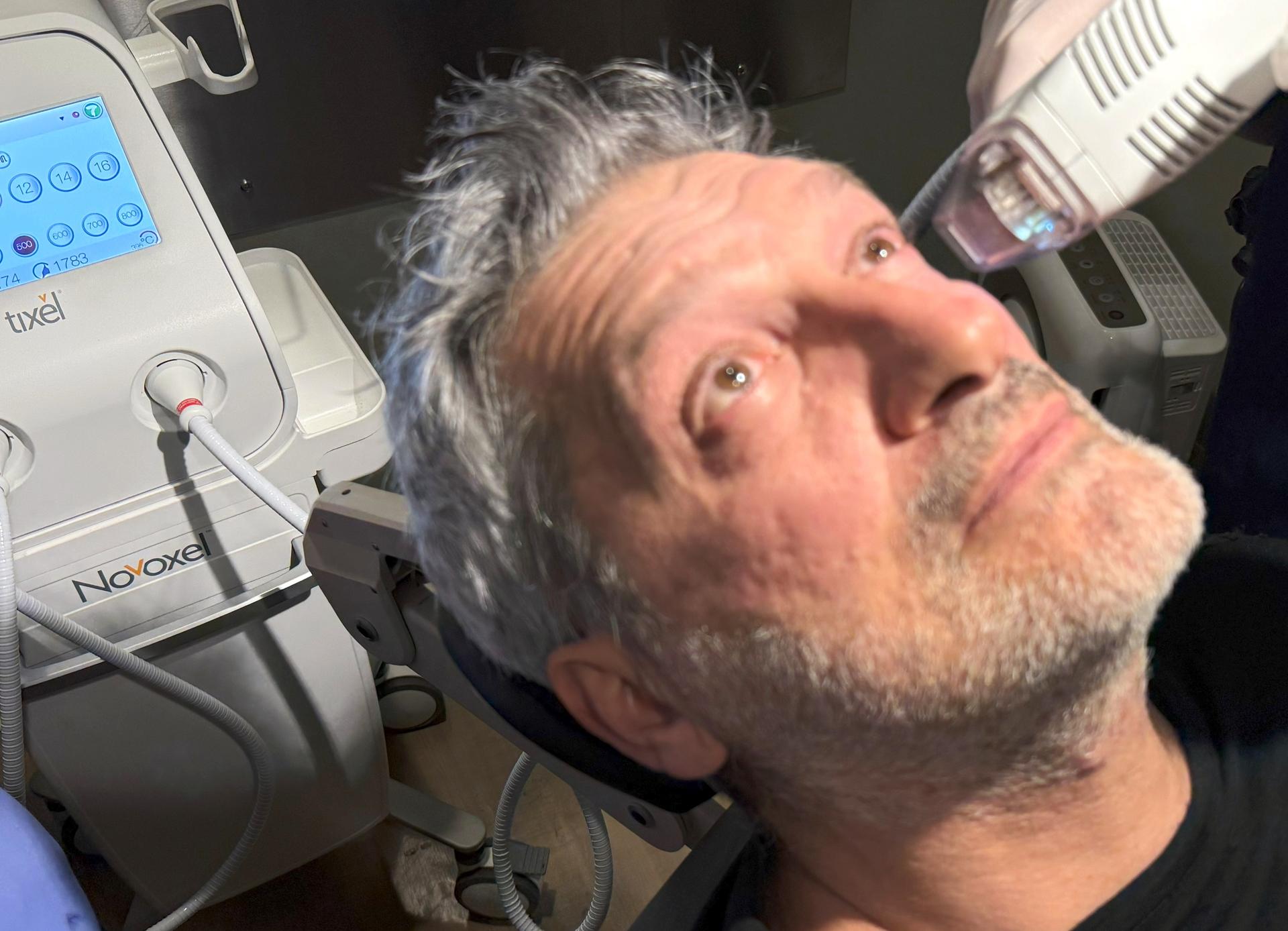
We installed it a month ago.

THE END

THE MILLION DOLLAR TREATMENT (2)

Back

SEE WHAT OURPATIENTS HAVE TO SAY

Posted on Google Google
Jim B profile picture
Jim B
Google star 1Google star 2Google star 3Google star 4Google star 5Trustindex verifies that the original source of the review is Google.
Everyone is always pleasant and kind and attentive. Focused and on schedule.

Owner's reply
Thank you for your wonderful feedback, Jim! We're thrilled to hear you had a great experience from start to finish. Your recommendation means a lot to us! We look forward to serving you again in the future.
Posted on Google Google
Nick Ben-Meir profile picture
Nick Ben-Meir
Google star 1Google star 2Google star 3Google star 4Google star 5Trustindex verifies that the original source of the review is Google.
Efficient service, and Dr Benjamin ahead of the curve, as always

Owner's reply
Thank you for your 5-star review, Nick!
Posted on Google Google
sharon piehl profile picture
sharon piehl
Google star 1Google star 2Google star 3Google star 4Google star 5Trustindex verifies that the original source of the review is Google.
Everyone was very kind and I felt comfortable being there for the first time.

Owner's reply
Dear Sharon, Thank you so much for your kind review. We’re so glad to hear that you felt comfortable and well cared for during your first visit. We truly appreciate you choosing Benjamin Eye Institute and look forward to seeing you again. The Benjamin Eye Institute Team
Posted on Google Google
Luba Lubov profile picture
Luba Lubov
Google star 1Google star 2Google star 3Google star 4Google star 5Trustindex verifies that the original source of the review is Google.
Great experience and I recommend this eye doctor.

Owner's reply
Thank you, Luba, for your very kind words! Looking forward to seeing you soon at Benjamin Eye Institute!
Posted on Google Google
Peter Trivelas profile picture
Peter Trivelas
Google star 1Google star 2Google star 3Google star 4Google star 5Trustindex verifies that the original source of the review is Google.
Profesional, skilled, personal, friendly.

Owner's reply
Thank you so much, Peter! Your kind words mean a great deal to us!
Posted on Google Google
Marjorie Dick Stuart profile picture
Marjorie Dick Stuart
Google star 1Google star 2Google star 3Google star 4Google star 5Trustindex verifies that the original source of the review is Google.
Always the best! Beautiful office, beautiful , helpful staff, amazing customer service, all the best equipment, and the best doctor. They will take good care of you!

Owner's reply
Thank you so much, Marjorie! Your kind words mean a great deal to Dr. Benjamin and our entire team! We truly appreciate your trust!

Related Articles

Why Your “Redness Relief” Eye Drops Aren’t Helping (and might actually be hurting)

Why Your “Redness Relief” Eye Drops Aren’t Helping (and might actually be hurting)

August 13, 2026

If you first experience a disaster like dry eye, the fundamental rule and recommendation would be to speak with a skilled ophthalmologist before putting anything in your eyes. Since choosing a treatment requires more pathophysiological understanding than simply purchasing the first eye drops you see.

more
DRY EYE TREATMENT AT BENJAMIN EYE INSTITUTE

DRY EYE TREATMENT AT BENJAMIN EYE INSTITUTE

November 21, 2025

Constantly rubbing your eyes, forcing yourself to blink, depending on eye drops to achieve only temporary relief – it all prevents you from getting the most out of your life. Even if it feels like you've already tried everything, we are here to prove you still have options.

more
Combining Multiple Treatment Modalities: A Holistic Approach to Dry Eye Management

Combining Multiple Treatment Modalities: A Holistic Approach to Dry Eye Management

March 3, 2025

In the heart of Los Angeles, our practice stands alone in offering patients a truly comprehensive approach to dry eye disease. By integrating multiple cutting-edge technologies and treatment modalities, we address this complex condition from every angle, providing relief where single treatments often fall short.

more
Protect Your Eyes from Wildfire Smog, Windblown Dust, and Discover Advanced Dry Eye Relief

Protect Your Eyes from Wildfire Smog, Windblown Dust, and Discover Advanced Dry Eye Relief

January 15, 2025

With current wildfire smoke and Windblown Dust Advisory conditions affecting air quality, it’s crucial to take extra precautions to safeguard your eyes and overall health. Exposure to airborne particles can lead to irritation, dryness, and even exacerbate existing eye conditions like dry eye syndrome.

more
A Special Holiday Offer: Clear Vision Awaits!

A Special Holiday Offer: Clear Vision Awaits!

December 20, 2024

Dry eyes can impact your daily life, but there’s no better time to find relief and start the new year with clear, comfortable vision. At Benjamin Eye Institute, we’re offering an exclusive holiday promotion to help you take the first step toward better eye health.

more
EnVision by InMode: Your Path to Lasting Dry Eye Relief

EnVision by InMode: Your Path to Lasting Dry Eye Relief

February 26, 2024

At Benjamin Eye Institute, your vision and eye health are paramount. We're excited to introduce you to a revolutionary addition to our practice: EnVision by InMode. This advanced device combines the power of two remarkable applicators – Forma I and Lumecca I – to offer an effective and lasting solution for dry eye relief.

more
5 Reasons for Watery Eyes, And What to Do About Them

5 Reasons for Watery Eyes, And What to Do About Them

January 23, 2024

Watery eyes are annoying but did you know that they can also be a sign for a serious problem? If you’re dealing with persistent watery eyes, here are a few possible causes.

more
Upneeq Drops: Enhancing Vision and Appearance Without Surgery

Upneeq Drops: Enhancing Vision and Appearance Without Surgery

December 4, 2023

Low-lying lids affecting your holiday season? Introducing a Revolutionary Solution for Ptosis. At Benjamin Eye Institute, our commitment to offering the latest advancements in eye care brings us to the forefront of innovation. We're excited to discuss Upneeq, a groundbreaking, non-surgical treatment for ptosis, commonly known as droopy eyelids.

more

SCHEDULE YOURCONSULTATION TODAY!